The Day I Walked Into a Dance Class and Fell in Love with the Practice Saree
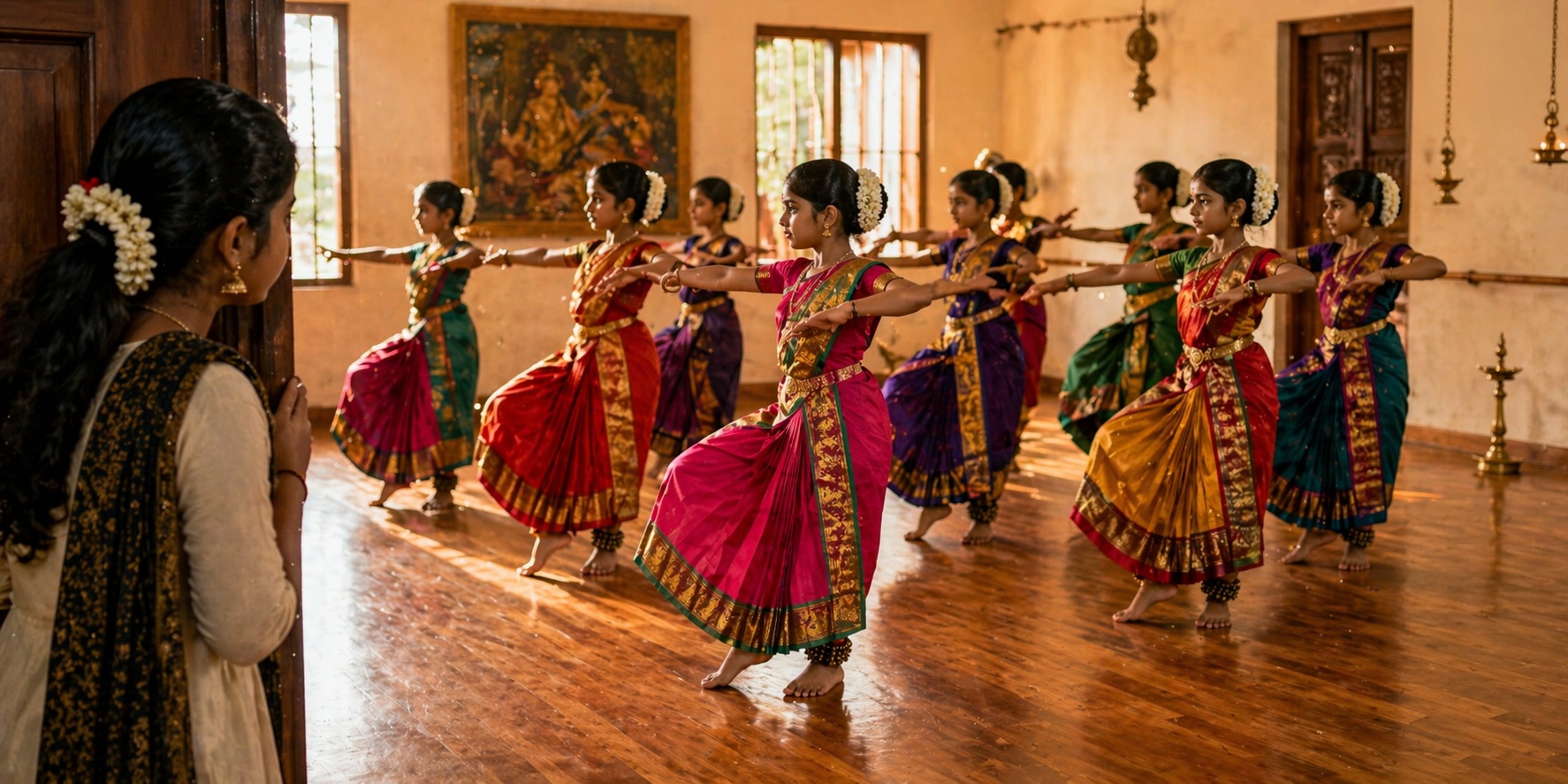
It was a regular afternoon in Vizag. I went to visit a well-known Kuchipudi and Bharatanatyam dance school to meet the teacher — a senior guru who has taught classical dance for over three decades. I arrived a few minutes early, and the class was still in progress.
I stood at the door and watched.
There were about fifteen students — some young girls of eight or nine, some teenagers, and a few older students. Every single one of them was wearing a practice saree. Not a uniform, not a churidar, not a random cotton saree thrown on in a hurry. Each girl was dressed in a neat, short practice saree — the pallu coming from behind, wrapping around, and tucked in firmly at the front — moving with a grace and confidence that honestly stopped me in my tracks.
The colours were beautiful. Some wore deep kalamkari prints — rich ochres and indigo blues with peacock and lotus motifs. Others wore bold Pochampally ikkat sarees in geometric patterns. A few of the younger girls were in bright cotton sarees with gold zari borders. The class looked like a painting — disciplined, vibrant, and deeply rooted in tradition.
And the movement! Because the practice sarees were only 3 feet in height — much shorter than a regular saree — the fabric stayed neatly above the feet. Every stamp rang out through the gajjelu. Every aramandi was clean and unobstructed. The students moved freely, without once worrying about tripping on loose fabric or readjusting a slipping drape.
When the class ended and I sat down with the guru, I told her — I have never seen a class look this beautiful just in practice. She smiled and said,
"A student who dresses like a dancer, dances like a dancer."
What Makes a Dance Practice Saree Special
A classical dance practice saree is not just any saree worn for class. It is a specially made saree with its own unique dimensions — designed entirely around the needs of a dancer.
The most important difference is the height. A regular saree is 4 to 4.5 feet tall — beautiful for everyday wear, but far too long for vigorous dance practice. A dance practice saree is only 3 feet in height. This shorter fall keeps the fabric well above the feet, giving the dancer complete freedom to stamp, kick, sit in aramandi, and execute fast footwork without any fabric coming in the way.
The length is standard at 5.5 metres — same as a regular saree — so there is enough fabric to drape properly. The pallu comes from the back, wraps all the way around the body, and is tucked firmly at the front. It is a regular saree drape style — because of the 3-foot height, it sits short and neat, perfect for dance.
This simple difference in height is what separates a dance practice saree from everything else. It is why, the moment you see a class full of students wearing them, it looks so right.
Cotton, Kalamkari, Ikkat, Zari — Which Fabric Is Right for Your Dancer?
Practice sarees come in a range of fabrics, each with its own character. Here is a simple guide:
-
Plain Cotton: The most practical everyday choice. Soft, light, breathable — ideal for young students and for long summer classes. Washes easily and holds its shape well. A good plain cotton practice saree in a bright colour with a simple border is all a beginner needs to start.
-
Kalamkari: For the student who wants her practice wear to reflect the beauty and culture of Andhra Pradesh itself. Kalamkari sarees feature hand-painted or block-printed traditional motifs — peacocks, lotuses, temple borders — in earthy, warm tones. Cotton or cotton-silk based, they are practical enough for class and stunning enough to make every practice feel special.
-
Ikkat (Pochampally): Bold, geometric, and unmistakably Telugu — Pochampally ikkat sarees are woven with a strong cotton or cotton-silk weave that holds the drape beautifully during energetic movement. The distinctive blurred patterns look vibrant in a dance class setting and photograph wonderfully during rehearsals and student showcases.
-
Cotton with Zari Border: The best of both worlds — the practicality of cotton with a touch of elegance from a gold or silver zari border. These sarees are perfect for annual day rehearsals, demo classes, and semi-formal school performances where the student needs to look polished without being in a full stage costume.
No Time to Drape? The Stitched Practice Saree Is a Game Changer
Not every parent knows how to drape a practice saree correctly — and not every child has the patience to stand still while it is being draped before class! This is exactly why the stitched practice saree has become so popular, especially for younger students.
A stitched practice saree is a ready-to-wear version where the front kuchhulu (pleats) are pre-stitched and the pallu is fully stitched in place. The dancer simply steps into it and wears it — no draping skills needed, no pins, no adjustments. It looks exactly like a properly draped practice saree but takes just a minute to put on. For young students especially, this means more time dancing and less time fussing with fabric before class.
It is also a wonderful option for dance academy owners who want all their students in uniform practice wear. A stitched practice saree in a single colour across the class creates a beautifully disciplined look during group rehearsals and annual day performances.
The 3-Piece Stitched Practice Set — Made for Kuchipudi Students
For Kuchipudi students who are a little more advanced in their training, there is an even better option — the 3-piece stitched Kuchipudi practice set. This fully stitched, ready-to-wear set mirrors the Kuchipudi stage costume, making it ideal for students preparing for performances or simply wanting to practise in something closer to what they will wear on stage.
The 3-piece set consists of: a blouse (choli), a stitched skirt and pavada (skirt) with the signature Kuchipudi side fan already stitched in, and a separate pallu piece. The side fan — that beautiful, distinctive panel that flares out at the side and is unique to Kuchipudi — is already perfectly set. The student wears the set in minutes and immediately looks and feels like a Kuchipudi dancer.
For students working towards their rangapravesham or preparing for a major competition, practising in the 3-piece set regularly means the full stage costume will feel completely natural when the time comes. The body already knows how to move in it.
I think about that dance class often — all those students moving together, each one dressed neatly in her practice saree, the gajjelu ringing with every beat, the kalamkari and ikkat colours catching the afternoon light. There was something deeply right about it. A student who dresses for her art takes her art seriously. And that seriousness shows — in how she moves, how she holds herself, and one day, how she performs.
🪷 Sudha Fashions, Vizag — Classical Dance Costumes & Practice Wear
We carry a wide range of practice sarees in cotton, kalamkari, ikkat, and cotton-zari — as well as ready-to-wear stitched practice sarees and the 3-piece Kuchipudi practice set. For individual students, teachers, and dance academies across Vizag and Andhra Pradesh. Come visit us in Visakhapatnam.
#PracticeSaree #KuchipudiPractice #BharatanatyamPractice #DancePracticeWear #KalamkariSaree #IkkatSaree #PochampallySaree #KuchipudiDress #ClassicalDance #AndhraPradesh #Vizag